What a CRM actually needs on day one
Contacts, companies, a pipeline with stages, tasks, and a timeline. Everything else is an argument you can have in month three.
The short answer
- A CRM needs five things before anything else: contacts, companies, a pipeline with named stages, tasks, and a timeline showing what happened on each record.
- Automation and AI features added before the record model is settled do not fix a messy database, they move messy data around faster and make the mess harder to trace.
- Stages are the most consequential decision on day one, because every forecast, report and automation you build later reads them, and renaming them afterwards rewrites history.
- SalesCrew ships contacts, companies, a deals kanban with stages, probability and weighted forecast, tasks, meetings, notes, a timeline and files, which is the whole day-one list.
The temptation is to start at the interesting end
Nobody gets excited about a contact table. The features that get demoed, and the ones a team asks about first, sit further down the stack: automated sequences, scoring, AI drafting, dashboards. So most CRM rollouts start by configuring one of those, and treat the underlying records as a detail to sort out along the way.
That order fails for a plain reason. Every one of those later features reads the record model. A cadence sends to contacts. A forecast reads deal stages and probabilities. A score ranks records against each other. An agent drafting a reply reads the thread, the contact and whatever history the timeline holds. If the records underneath are inconsistent, all you have built is a faster way to act on inconsistent records.
The damage is worse than doing nothing, because automation removes the friction that used to catch mistakes. A person working from a messy list notices the duplicate, notices the company name that is obviously the same firm spelled two ways, and quietly works around it. A cadence does not notice. It sends to both.
The five things, and what each one is actually for
Contacts and companies, as separate objects. This sounds obvious and gets skipped constantly, usually by teams who start with a flat list of people and a company name typed into a text field. The moment two people at the same firm are in your database, you need the firm to be a record rather than a string, or you cannot answer "what is happening with this account" without a text search. Getting this wrong is expensive to undo, because every later record points at the wrong thing.
A pipeline with named stages. Stages are the most consequential decision on day one and the one most often made carelessly. They define what "progress" means for your team, and everything downstream reads them: the forecast, the reports, the automation rules, and any agent policy about when a stage may change. Name them after observable events, not feelings. "Proposal sent" is a fact; "interested" is an opinion, and two reps will apply it differently within a week. SalesCrew's deals kanban carries stages with probability and a weighted forecast, which only produces a meaningful number if the stages themselves mean something consistent.
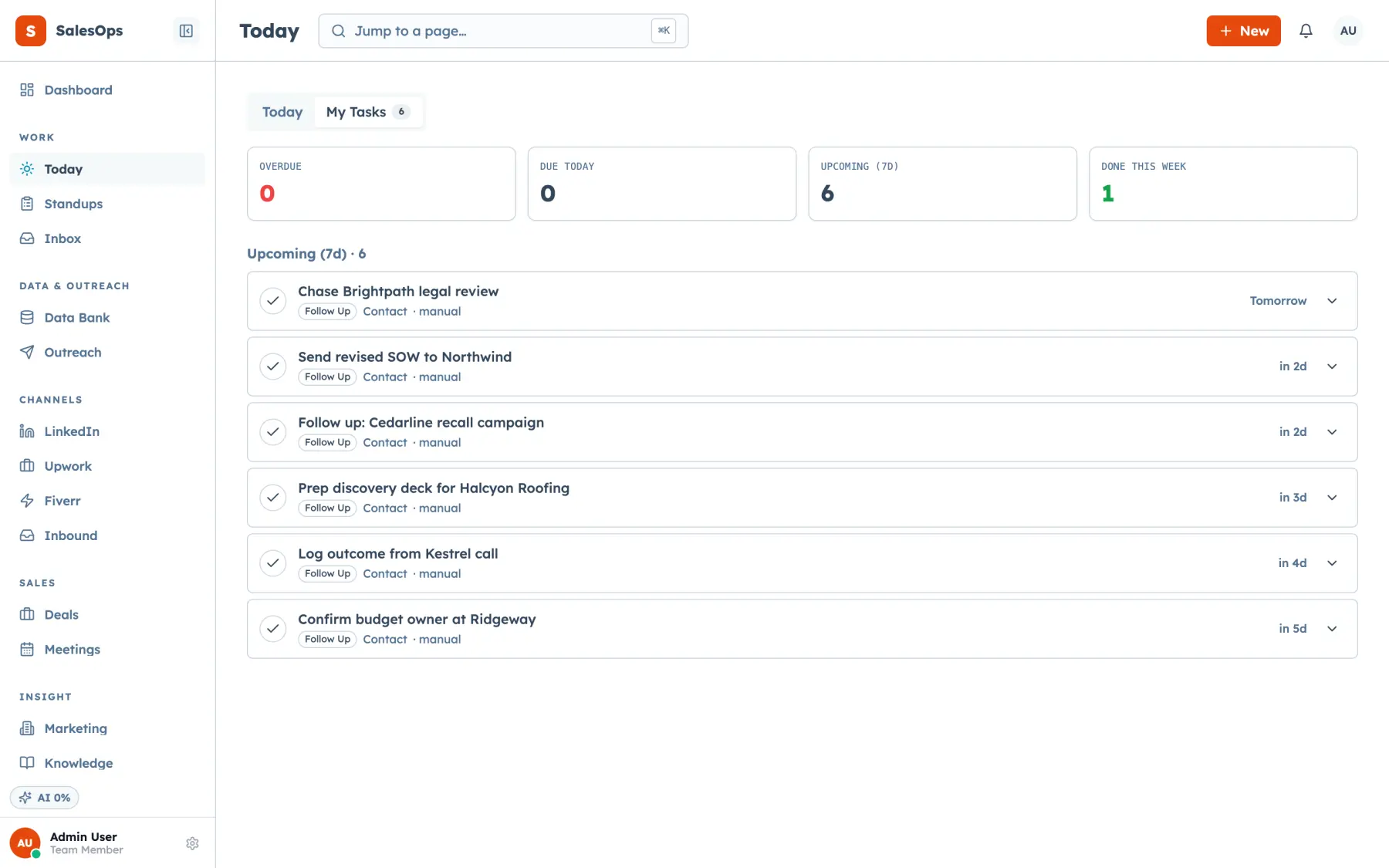
Tasks. A CRM without tasks is a filing cabinet. The reason a team opens the system in the morning is to find out what they owe someone today, and if the answer lives in a separate to-do app, the CRM becomes something they update after the fact rather than work from.
A timeline. This is the record of what happened: notes, meetings, emails, calls, stage changes. It is what makes a record legible to the second person who touches it, which is every record eventually. Without it, the state of an account lives in one rep's memory, and a handover means an hour of conversation instead of a page of history.
These are the objects SalesCrew ships as the core: contacts, companies, a deals kanban, tasks, meetings, notes, a timeline and files. That list is not modest by accident. It is the set of things that have to be right before anything clever is worth building on top, which is why they were built first rather than alongside.
What to do in the first week
Import contacts and companies, and resolve duplicates before you do anything else with them. Duplicate handling is not glamorous and it does not get easier later, because later there are notes, deals and email threads attached to both copies of the same person, and merging becomes a decision about which history to keep rather than a cleanup.
Write your stages down and argue about them once, properly, with whoever runs the numbers in the room. Then change them as rarely as you can stand. Renaming a stage after three months of use does not only change a label; it changes what every historical deal means, and any report that compares this quarter to last quarter now compares two different definitions.
Get one team member working entirely inside the system for a week before you configure anything automated. What they complain about is your real requirements list, and it is usually shorter and more specific than the feature comparison you started from. Only then add sending, sequences or agents, in that order, because that is the order of how much damage a mistake does.
When you do reach automation, the record model you built is what makes it safe to review. An agent that drafts a reply is only checkable if a human can see the thread, the contact and the history that produced the draft. Every control that comes later, the approval queue, the guardrails, the audit log, depends on there being a well-formed record to point at. Day one is not a slower start. It is the part that makes the fast part possible.
Questions
- Is lead scoring part of day one?
- No. Scoring ranks records against each other, so it needs records with enough history to rank. A score computed on a database that was populated last week mostly reflects who happened to be imported first. It belongs after the record model has been carrying real activity for a while.
- What about custom fields?
- Later, and deliberately later. Custom fields are the easiest way to encode a process you have not finished designing, and they are unpleasant to remove once reports depend on them. Run on the standard objects until you can name the specific decision a new field would change.
- Should the first setup include email sending?
- Only after contacts and companies are clean, because sending is the one action that reaches outside the building and cannot be undone. Reading and recording can be fixed quietly; a message sent to the wrong list cannot.