How to manage many sending mailboxes
Put every mailbox in one pool, cap each one per day and per domain, rotate new contacts across them, and suppress every bounce everywhere.
The short answer
- Many sending mailboxes are managed as one pool: each mailbox has a daily cap, each domain has a daily cap, and a campaign spreads its contacts across whatever capacity is left.
- Inbox rotation assigns new contacts to mailboxes, not individual steps. A contact stays on one mailbox for the whole thread, so follow-ups read as one conversation.
- A bounce or complaint on any mailbox should suppress that address for every mailbox. Otherwise the pool keeps retrying a dead address from a fresh inbox.
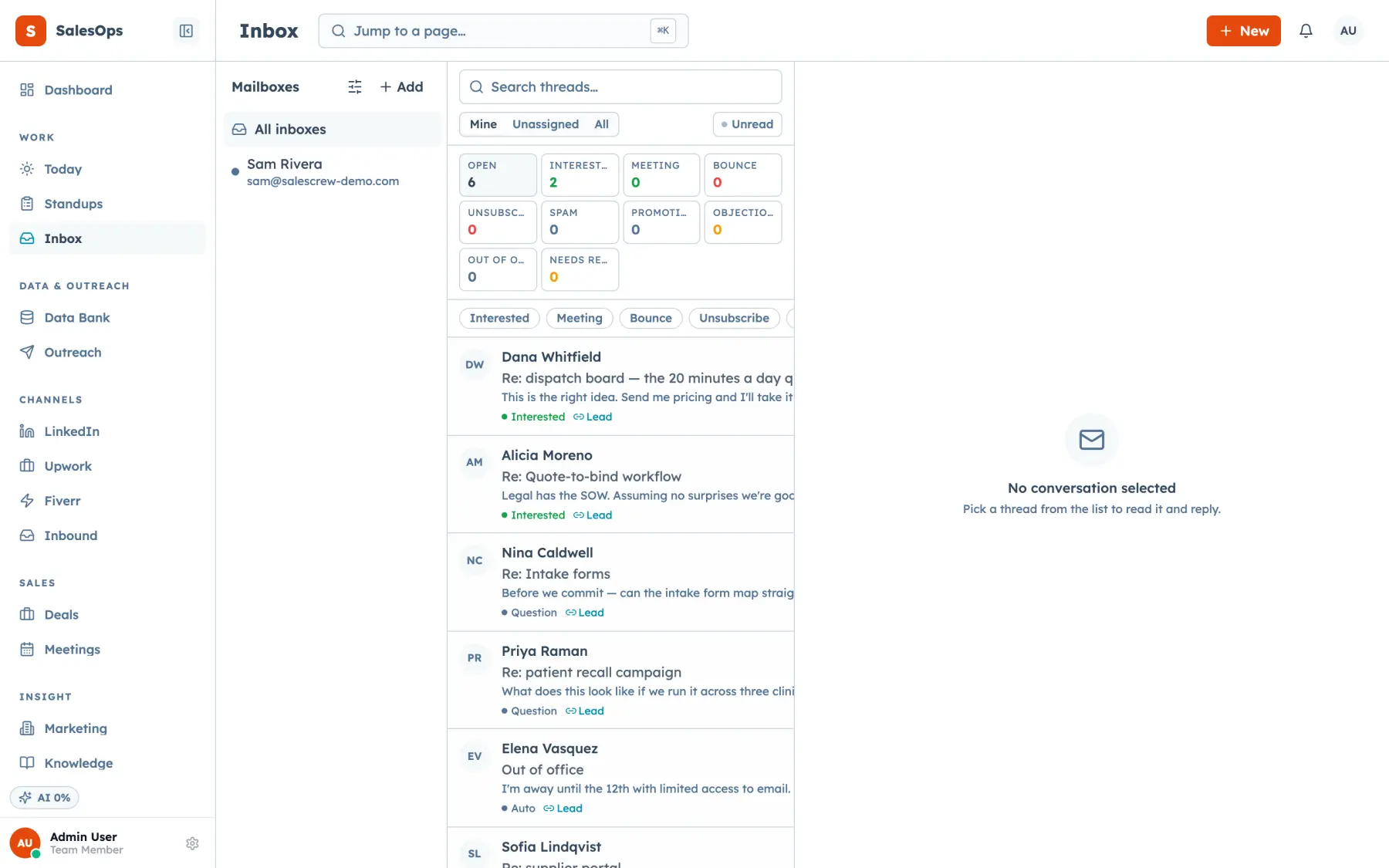
- SalesCrew sends cadences through its own mailbox pool, with per-mailbox and per-domain daily caps, a cooldown on each mailbox and suppression checked at send time.
Why a spreadsheet of logins stops working at around ten mailboxes
With three mailboxes, you can log into each one and watch it. At ten, you can't. You lose track of which inbox sent what, which domain is near its limit, and which one started bouncing on Tuesday.
The fix is to stop thinking in mailboxes and start thinking in capacity. Your pool has a fixed number of sends it can make today. A campaign asks for some of that capacity, and the pool decides which mailbox sends each email. You manage the rules once, and every campaign follows them.
Set up a sending pool in five steps
- 1
Spread mailboxes across domains
Put two or three mailboxes on each sending domain, never your main website domain. If one domain gets flagged, the others keep sending.
- 2
Set a cap per mailbox and per domain
A mailbox cap stops one inbox running hot. A domain cap stops three mailboxes on the same domain adding up to too much.
- 3
Rotate contacts, not steps
Each new contact is assigned to the mailbox with room left. Every later step for that contact goes out from the same mailbox.
- 4
Send inside business hours
Keep sends inside the prospect's working day and leave gaps between them. A burst of 50 emails at 9:00 looks like what it is.
- 5
Suppress bounces across the pool
One bounce or complaint on any mailbox blocks that address on all of them, and the bad mailbox comes out of rotation.
Worked example: how much a pool can send each day
Capacity is mailboxes times the per-mailbox cap, limited by the domain cap. Your own caps set the real numbers.
| Pool | Mailboxes | Cap per mailbox | Cap per domain | Daily capacity |
|---|---|---|---|---|
| Small | 6 on 3 domains | 30 | 60 | 180 emails |
| Medium | 20 on 10 domains | 30 | 60 | 600 emails |
| Large | 60 on 20 domains | 40 | 100 | 2,000 emails |
The domain cap binds in the large pool: 3 mailboxes at 40 would allow 120 per domain, but the 100 cap holds each domain to 100. Google's bulk-sender threshold of 5,000 messages a day to Gmail, checked on support.google.com/a/answer/81126 in September 2026, applies across a whole sending domain.
Watch three numbers per mailbox every day
Bounce rate, spam complaints and replies tell you almost everything. Google's sender guidelines set 0.3% as the spam complaint rate to stay under, as of September 2026. A mailbox whose bounces climb in a day should leave the pool before it drags the domain down with it.
Replies matter for a different reason. A mailbox with zero replies over a week is probably landing in spam, even if bounces look clean. Rest it, fix the cause, and bring it back at a lower cap.
How SalesCrew runs the pool for you
SalesCrew sends cadence steps through a native mailbox pool built from the mailboxes you connect over IMAP and SMTP. Each send checks the per-mailbox and per-domain daily caps, stamps a cooldown on the mailbox, and re-checks suppression at the moment it goes out. Bounces and complaints add the address to suppression for every mailbox.
Replies land in the unified inbox, so your team works one thread list instead of fifty logins. If you run your warmup fleet in Instantly, SalesCrew mirrors that sender and domain registry. The pool comes with every plan, starting with Core at $299 a month with unlimited seats.
Adding mailboxes won't fix a bad list
Questions
- What is inbox rotation in cold email?
- Inbox rotation spreads one campaign across many sending mailboxes, so no single inbox carries the whole volume. Each send goes to the next mailbox with room left under its daily cap. The prospect sees one sender for the whole thread, because replies and follow-ups stay on the mailbox that sent the first email.
- How many emails should each mailbox send per day?
- Pick a low, fixed cap per mailbox and hold it. Around 30 to 50 cold emails a day is the range many teams use. That sits far below the 5,000-a-day line where Google's bulk sender guidelines start to apply, checked September 2026.
- Should follow-ups come from the same mailbox?
- Yes. A follow-up from a different address breaks the thread and looks like a second stranger writing. Pin each contact to the mailbox that sent step one, and let rotation spread new contacts, not steps.
- What do I do when one mailbox starts bouncing?
- Pull it out of the pool the same day. Every bounced address goes on your suppression list so no other mailbox tries it. Then check the domain's DNS records and the list source before the mailbox sends again.