How do you run sales as a two-person company?
One shared system for every lead, a strict follow-up habit, and fewer channels run consistently. Not a scaled-down copy of a ten-rep team's process.
The short answer
- A shared system both people use for every lead matters more at two people than at twenty. There is no manager or ops person to notice when something falls through a gap between two separate tracking habits.
- A spreadsheet can work briefly for a handful of leads. It has no way to prompt a follow-up at the right time. That is precisely the failure that costs a small team the most: leads that simply get forgotten.
- Running fewer channels consistently beats running many channels inconsistently. A two-person team has limited capacity. Quality of follow-up on one or two channels matters more than nominal presence across several.
- Copying a larger sales team's process, dedicated roles, elaborate stage definitions, many parallel channels, usually adds overhead a two-person team cannot sustain rather than improving results.
Why copying a bigger team's process backfires at this size
It is common for a small founding team to look at how larger sales organizations operate, dedicated SDRs, several parallel outbound channels, detailed pipeline stages with formal handoffs, and try to copy a version of that early. At two people, this usually adds overhead without adding capacity to execute it. A pipeline with ten finely divided stages is not more useful than one with five if no one is available to move leads through the extra steps. It just adds friction two people do not have spare time for.
What matters at this size is simpler and more basic. Every lead lands in one place both people can see. Follow-up happens on a consistent schedule rather than depending on memory. The channels used are limited to what two people can maintain at a quality level, rather than spread thin across everything a larger team might attempt.
What actually matters at two people
| Priority | Why it matters more at this size |
|---|---|
| One shared system for every lead | No manager or ops layer exists to catch gaps between separate tracking |
| Consistent follow-up timing | A forgotten lead is a bigger relative loss with so few leads to begin with |
| Fewer channels, run well | Limited capacity makes quality on fewer channels beat thin coverage on many |
| Simple pipeline stages | Elaborate stages add overhead with no team to execute the extra steps |
What to actually set up
Put every lead into one system both people check, with a simple pipeline that reflects your real process rather than a copied template. Pick one or two channels you can realistically maintain. Build a basic follow-up habit, a defined cadence, rather than relying on memory. Resist adding complexity, more stages, more channels, more process, until the team has grown enough to need it.
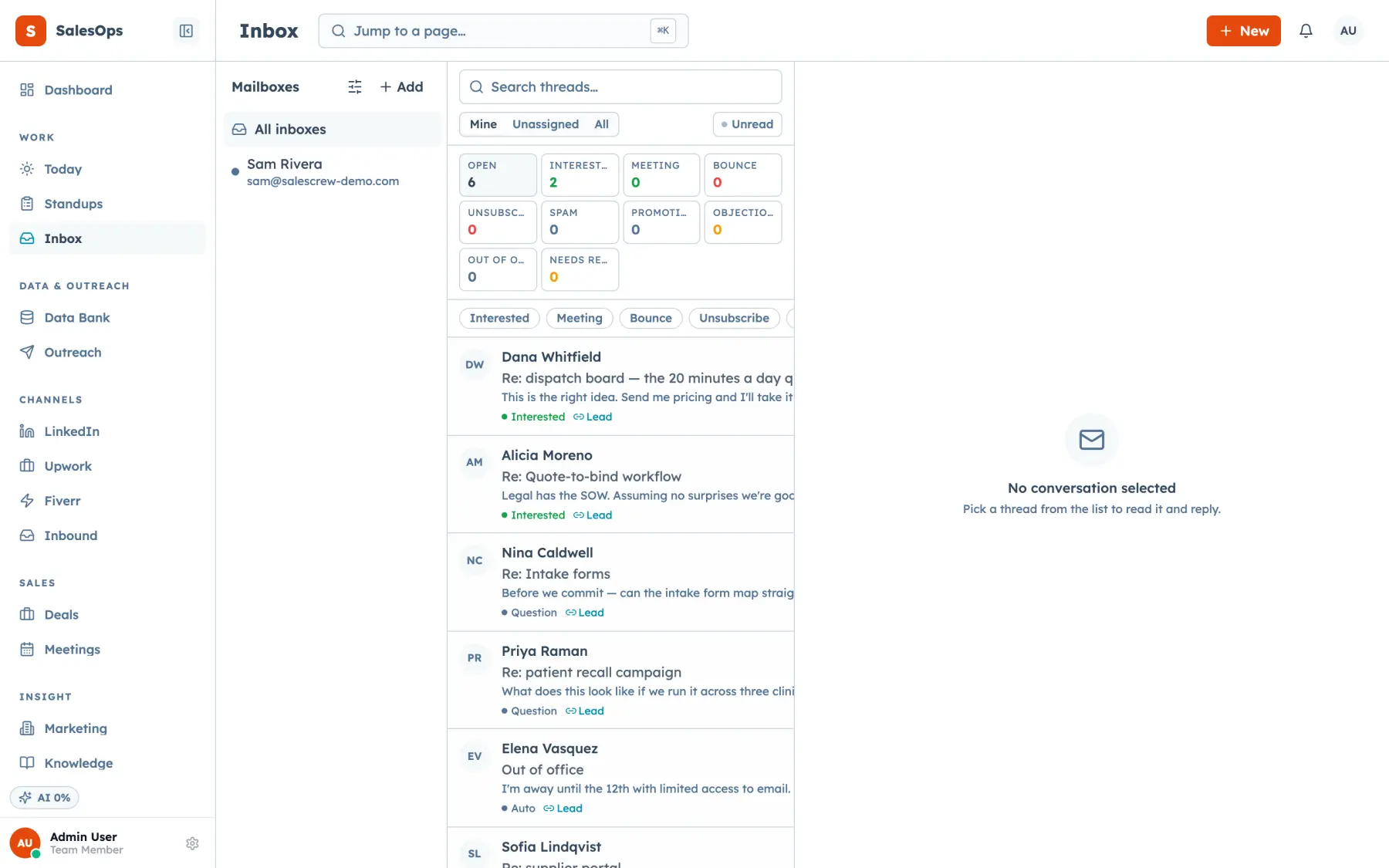
Disclosure: SalesCrew is our product. It is priced with unlimited seats on every tier because a two-person team should not pay a per-seat penalty for using one shared system properly. Pipeline, cadences and inbox all live in one place from day one.
Copying a larger team's process usually adds overhead, not results
Questions
- Is a spreadsheet good enough at this size?
- It can work for a short period with very few leads. It breaks down quickly once follow-up timing matters. A spreadsheet has no way to remind anyone when a lead needs a touch, which is exactly where small teams lose the most business.
- Should both founders use the same system, or can each track their own leads separately?
- The same system, always. Separate tracking means neither person has the full picture. A lead one person is working can easily get a duplicate or conflicting outreach from the other without anyone noticing.
- How many channels should a two-person team try to run at once?
- Fewer than feels ambitious. One or two channels run consistently outperform four channels run inconsistently. A two-person team has limited capacity to keep quality up across many channels at once.