How to build a reusable client setup
A reusable setup is a configuration you apply, not a checklist someone follows. Build the structural pieces once, then fill in each client's specifics on top of it.
The short answer
- A reusable client setup is the actual configuration (pipeline stages, cadence steps, disposition codes, report structure) exported once and re-applied to new accounts, not a document that instructs a person to rebuild it manually each time.
- Split configuration into structural elements that repeat across clients (stage names, standard cadences, reporting layout) and content elements that are unique per client (their contacts, their branding, their specific KPIs); only the structural half belongs in the reusable template.
- A setup is worth templating once a pattern has repeated three or four times across real client onboardings; templating something still being figured out usually costs more time than it saves.
- Maintaining one canonical version of the template, updated as the process improves, avoids a common failure where every client ends up on a slightly different, undocumented variant that no one can trace back to a source.
Why a checklist is not the same as a reusable setup
Many agencies write an onboarding checklist: steps to follow, fields to fill in, stages to create. That is genuinely useful, but it still requires a person to manually rebuild the same pipeline stages, the same disposition codes, and the same report structure inside the CRM every time a new client is onboarded. The checklist reduces the chance of forgetting a step; it does not reduce the actual work of typing the same configuration in again.
A reusable setup goes one level deeper: the configuration itself, not only the instructions for creating it, is captured in a form that can be applied to a new account directly. That might be a documented set of exact field values a team copies in quickly, or a tool-level export/import feature that moves the configuration wholesale. Either way, the goal is that a new client's account starts already built to the standard shape, and the only work left is filling in what is actually unique to that client.
The distinction matters because checklists drift. Two people following the same checklist six months apart, working from memory of "how we usually do it," reliably produce slightly different results. A reusable configuration does not drift the same way, because there is one canonical version being applied, not a set of instructions being reinterpreted each time.
What usually belongs in the template versus what doesn't
| Element | Template (structural) | Per-client (content) |
|---|---|---|
| Pipeline stages | Yes, standard stage names and order | Not applicable |
| Disposition / outcome codes | Yes, standard set | Not applicable |
| Cadence steps and timing | Yes, standard sequence shape | Message copy personalized per client |
| Report layout and sections | Yes, standard structure | The actual numbers and commentary |
| Contacts and companies | No | Yes, unique to each client |
| Branding, logo, subdomain | No | Yes, unique to each client |
How to actually build one
Start from the client type you onboard most often, not an idealized universal template. Take the last two or three onboardings of that type, note which pipeline stages, cadences, and report sections were essentially identical, and use that as the first version of the template. Expect to revise it after the next couple of onboardings; a template built from too few examples tends to include one-off details that were never actually standard.
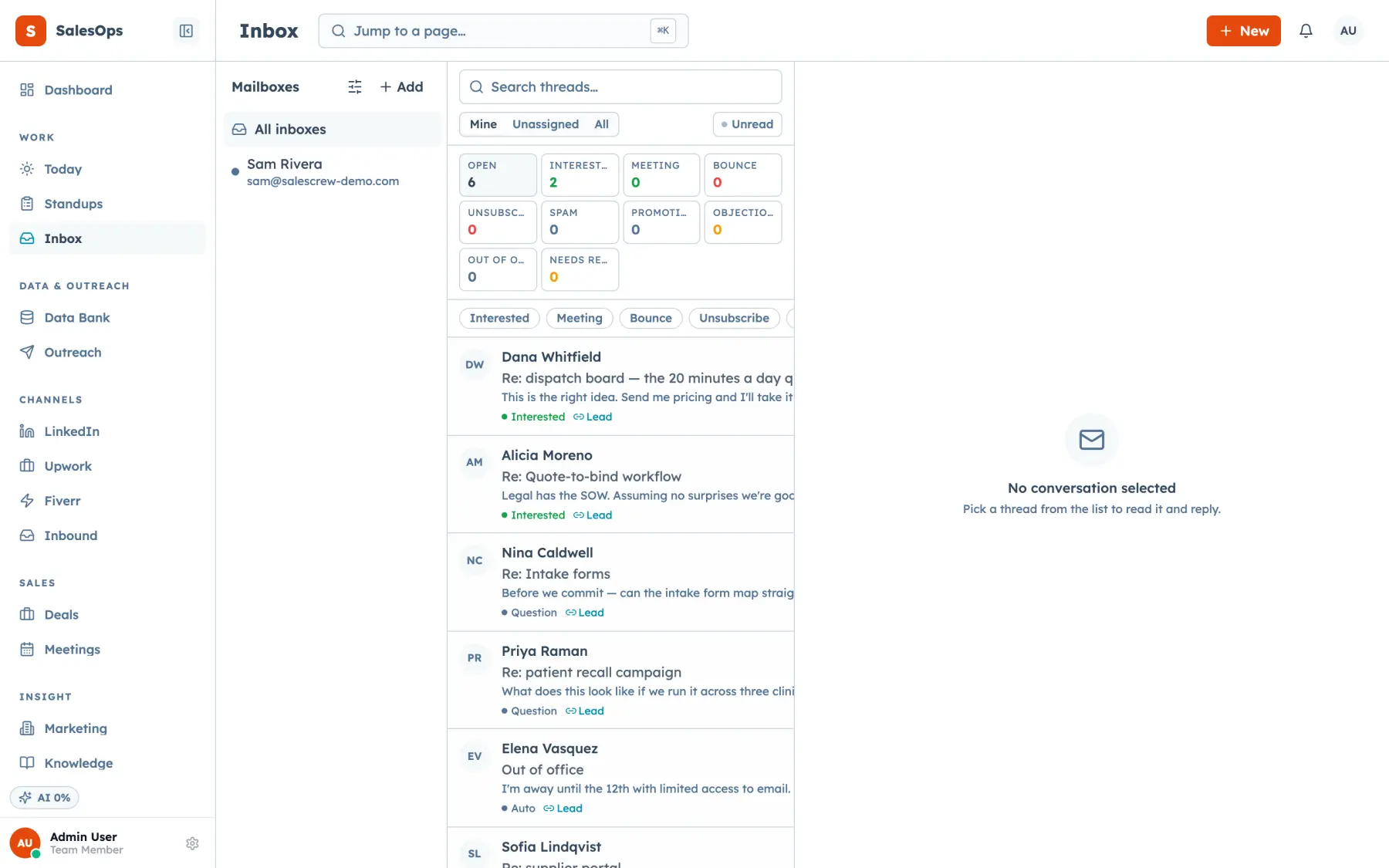
Disclosure: SalesCrew is our product. It has a snapshot feature that exports a configured instance's setup (pipeline stages, cadences, agent policy) and applies it to a new client instance, which is the mechanism for this without manual re-entry. Building the right template content is still a judgment call based on your own onboarding patterns; the export tool moves what you have already designed, it does not design it for you.
A stale template is worse than no template
Questions
- What is the difference between a reusable setup and a template document?
- A template document (a checklist or slide deck) tells a person what to configure; a reusable setup is the actual configuration, exported and re-applied, so a new client account starts already built rather than starting from a document someone has to follow by hand.
- How do you handle the parts that genuinely differ per client?
- Separate what is structural (pipeline stages, disposition codes, report layout) from what is content (the client's own contacts, branding, specific targets). The structural part is what should be reusable; the content part is what gets filled in after the template is applied.
- When is it worth building a reusable setup versus configuring each client manually?
- Once onboarding the same type of client for the third or fourth time, the patterns that repeat are usually clear enough to template. Before that, manual configuration is often faster than building and maintaining a template for something still being figured out.