Can two agents work the same pipeline?
Yes, if each has a distinct scope and the system serializes writes and deduplicates scheduled actions. Otherwise they collide: two follow-ups sent to one contact, two conflicting stage moves. Design agents per job, not per pipeline.
The short answer
- Two agents can safely work the same pipeline if each has a distinct, non-overlapping scope. The system must also serialize writes to any record both could touch, and deduplicate scheduled actions, so the same follow-up cannot be queued twice.
- Without those two protections, agents with overlapping responsibility collide. Two agents both deciding a contact needs a follow-up send two. Two agents both reasoning about a deal's stage move it in conflicting directions within the same day.
- The fix is not fewer agents. It is scoping them by job rather than by pipeline. An agent that drafts follow-ups and an agent that scores leads can coexist on the same pipeline, because their jobs do not overlap even though the records do.
- Two agents with overlapping, loosely defined instructions, like both being told to 'clean up stale records', are the worst case. Without coordination, they can undo and redo each other's changes indefinitely. Neither is aware the other exists.
Why collisions happen even when each agent is behaving correctly
It is tempting to assume a collision means one of the agents is malfunctioning. Usually neither is. Each agent, reasoning independently over the same record, can reach a reasonable conclusion on its own. This contact looks due for a follow-up. This deal looks ready to advance. The problem is not that either conclusion is wrong in isolation. Neither agent knows the other reached a similar conclusion at nearly the same time. Without a mechanism to prevent it, both act.
This is a coordination problem, not a reasoning problem, and it needs a coordination fix. Serializing writes, so the system processes one write to a given record before allowing the next, closes the most direct version. Deduplicating scheduled actions closes a related one. If two agents both decide to schedule tomorrow's follow-up to the same contact, the system should recognize the duplicate and only send one.
Collision, cause, and prevention
| Collision | Cause | Prevention |
|---|---|---|
| Two follow-ups sent to one contact | Two agents independently decide a follow-up is due at nearly the same time | Deduplicate scheduled actions per contact before they execute |
| Conflicting stage moves on one deal | Two agents reasoning from different signals reach different conclusions | Serialize writes to deal records; keep stage changes in review regardless |
| Overlapping cleanup undoing itself | Two agents both told to 'clean up' with no shared definition of stale | Scope cleanup responsibility to one agent, or define the rule identically for both |
| Duplicate research or enrichment | Two agents both enrich the same record without checking recent activity | Check for a recent enrichment before running it again |
Scoping by job, not by pipeline, as the actual design principle
The safest way to run several agents against the same pipeline is to make sure their jobs do not overlap, even when the records they touch do. An agent that only drafts follow-ups and an agent that only scores leads can operate on the exact same deals without colliding. Neither one's job includes deciding what the other decides. The risk grows when two agents are given the same or overlapping responsibility, like both being asked to manage follow-up timing.
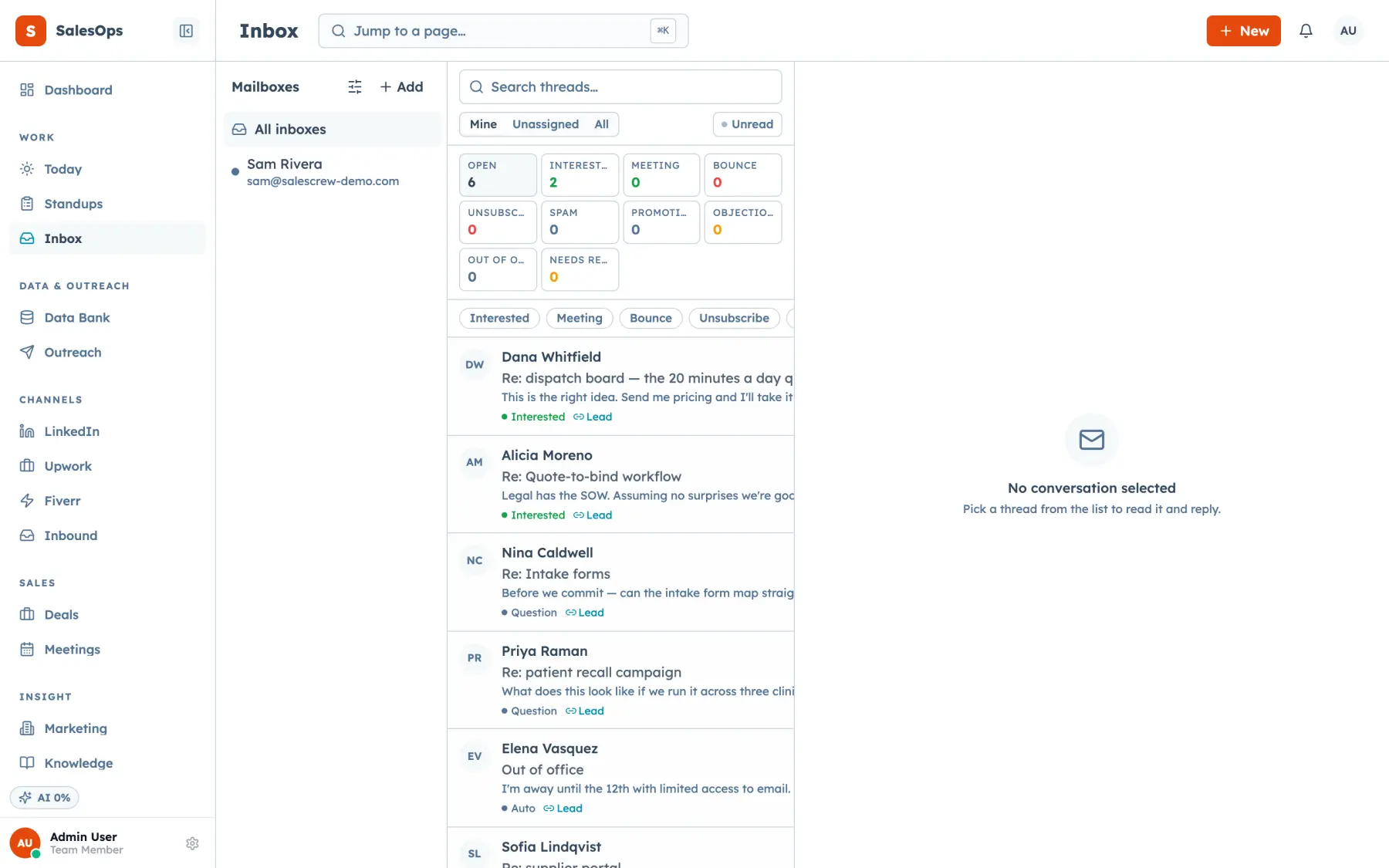
Disclosure: SalesCrew is our product, and its agents are scoped by job rather than by pipeline. The Inbox agent drafts replies. The chief-of-staff digest summarizes. Each operates within its own defined responsibility rather than a broad, overlapping mandate. Scheduled actions are deduplicated, and writes to a given record are processed in order. Two agents (or an agent and a person) acting on the same deal do not produce a race condition in the data.
Two agents with overlapping 'clean up' instructions can loop forever
Questions
- What does 'serialize writes' mean in practice?
- The system processes writes to a given record one at a time in a defined order. It does not let two agents' writes to the same record race each other and land in an unpredictable order. This is a database-level or application-level guarantee, not something the agents coordinate themselves.
- Is designing agents 'per job, not per pipeline' just a naming convention?
- No. It changes what scope each agent needs. A pipeline-scoped agent tends to accumulate broad permissions across everything in that pipeline. A job-scoped agent, like 'the agent that drafts follow-ups' or 'the agent that scores leads', has a naturally narrower scope tied to what it does.
- What is the actual failure when two agents have overlapping cleanup instructions?
- Each agent, acting on its own view of what counts as 'stale', can undo or redo the other's changes indefinitely. Neither knows the other exists or what it just did. This can loop without ever converging, unlike a single agent making a mistake once.